

A
BLUER THAN
BLUE GARDEN!
(A
LIST
OF TRUE BLUE FLOWERING BULBS AND PLANTS)
Perhaps the rarest flower color is blue, and sometimes seeing blue is a good thing. Here are some stunning blues, unique in today's colorful flower gardens. Maybe you are looking for unique blue flowers for a wedding or special occasion...likely it is pictured here. There are newer hybrids listed here, too. Not all blues are true blue. Many are shades of azure, lavender, purple, or violet. In fact, many so-called blue flowers are actually lavender or purple (apparently there are experts who can't tell the difference between blue and lavender).
Below are some of the bluest flowers available. Some are a rich deep blue, others a light sky blue. You will find a photo of each plant, a brief explanation, where to get it, and the zone hardiness rating (zone map at bottom).
Blue
Iris
|
This streaked variety (left) of Bearded Iris (Iris germanica), called Gnu Blues Zebra, is by hybridizer Brad Kasperek of Zebra Gardens. This hybrid has spectacular color breaks, patterns never before seen in iris. They can grow up to 40" tall, and have swordlike leaves that grow in attractive fans. Lightly ruffled blooms are blue with patches of medium to dark blue. Best Bet Shades of Blue (right) is another amazing blue Bearded Iris, reliably producing huge numbers of colorful blooms. Iris bloom in Spring and Summer, and sometimes again in the Fall. Bulbs (rhizomes) grow into crowded clumps, and should be divided every 3 to 4 years. Other incredible blues are Blue Sparks, Pacific Destiny, and Pacific Grove, all available from Newport Naturals. These perennials are hardy in zones 4-9. |
|
Blue
Tulip
 |
The Blue Parrot tulip is an amethyst or mauve blue (left), and the Blue Amiable Triumph Tulip (right) is a deep blue. The frilly ruffled petal and large flower of the Parrot variety make these different from all other tulips, and are very showy. The Blue Parrot grows up to 20 inches tall, and blooms in mid Spring. Tulips like rich soil, composted and sandy for good drainage. The Blue Amiable Triumph Tulip (right) is bluest tulip in existence, and grows up to 22 inches tall, blooming in mid Spring. In a sunny, protected spot some of Tulip species bloom as early as February. Blotched and striped varieties are known as “broken” tulips. Until recently, Tulips used to come in all colors except blue. Other varieties range in height from short to vary tall (Darwin) and bloom generally from early Spring to early Summer. Tulips grow best in zones 3 to 8. Tulips require special treatment in warm climates. Some varieties, including the Parrot are sold as "blue" though actually lavendar or purple, so be watchful. Purchase at Holland Bulb Farms, Tulip World or Gardens of the North. |  |
Blue
Larkspur
   Blue
Larkspur (Delphinium scaposum) are iridescent blue
in color, usually an
intense royal blue (far left), and are sometimes
lighter blue, such as
the desert blue variety (right). The densely
flowered spikes can
grow to 6 feet tall, or even 8 feet (called
giants). The more common
varieties grow to 2 feet tall. Larkspur like
full sun, and flower
from Spring to mid Summer. Blue
Larkspur (Delphinium scaposum) are iridescent blue
in color, usually an
intense royal blue (far left), and are sometimes
lighter blue, such as
the desert blue variety (right). The densely
flowered spikes can
grow to 6 feet tall, or even 8 feet (called
giants). The more common
varieties grow to 2 feet tall. Larkspur like
full sun, and flower
from Spring to mid Summer.
Grown in all zones, Larkspur is an annual. On the immediate left is a lesser known Chinese variety, Delphinium kamaonense. These rich blue flowers bloom July to October, and plants grow up to 3 feet tall. Plants and seeds are widely available at nurseries and garden shops. |
Blue
Lobelia
 |
Great Blue Lobelia (Lobelia siphilitica) is native to North America, is sometimes called the Blue Cardinal, and is a beautiful perennial plant for a shady garden or the edge of a water garden pond. Lobelia erinus is the annual variety. Blooms in mid Summer through early Fall with 3 feet spikes of electric blue flowers. Other Lobelia varieties have deep blue to rich purple flowers, and attract hummingbirds and butterflies. With a spread of 2 feet, Lobelia prefers moist sandy soil and partial shade, but will tolerate average garden conditions. Hardiness zones are 4-10. Seeds and plants available online from Prairie Frontier, Splendid Seeds and local nurseries. |  |
Blue
Delphinium
 |
 Delphinium
are an attractive genuine blue eye-catching
flower. They grow with
long spikes of large semi-double or double, light
to dark blue flowers
with even darker centers. They prefer full
sun and well drained fertile
soil. Although the prevailing wisdom is to
grow delphiniums in full
sun, you can grow great flowers in partial shade
as well. Delphinium
belongs in every garden and will provide weeks of
stunning blooms into
late Fall, year after year. Growing 4
to 5 feet tall (some
varieties up to 8 feet), you may need to stake the
spikes before the flowers
open. A hardy perennial, they grow best in
zones 3-8. Available
online from Renee's
Garden.
Plants and seeds are widely available at
nurseries and garden shops. Delphinium
are an attractive genuine blue eye-catching
flower. They grow with
long spikes of large semi-double or double, light
to dark blue flowers
with even darker centers. They prefer full
sun and well drained fertile
soil. Although the prevailing wisdom is to
grow delphiniums in full
sun, you can grow great flowers in partial shade
as well. Delphinium
belongs in every garden and will provide weeks of
stunning blooms into
late Fall, year after year. Growing 4
to 5 feet tall (some
varieties up to 8 feet), you may need to stake the
spikes before the flowers
open. A hardy perennial, they grow best in
zones 3-8. Available
online from Renee's
Garden.
Plants and seeds are widely available at
nurseries and garden shops. |
Blue
Salvia
   Salvias
(also known as Sages) flower for a long period,
and do well in hot, dry
conditions. They provide wonderful
fragrance, and are some of the
best summer-blooming annuals and perennials.
The species (left),
also known as Mealy Sage or Mealy-Cup Sage (Salvia
farinacea), can reach
three or four feet in height, with bright blue to
lavender flowers. They
are widely available at local nurseries, or
online from Mountain
Meadow Seeds. Bog Sage
(Salvia uliginosa) is a late
summer to fall bloomer with azure blue flowers on
a steadily spreading
plant (right). Salvias
(also known as Sages) flower for a long period,
and do well in hot, dry
conditions. They provide wonderful
fragrance, and are some of the
best summer-blooming annuals and perennials.
The species (left),
also known as Mealy Sage or Mealy-Cup Sage (Salvia
farinacea), can reach
three or four feet in height, with bright blue to
lavender flowers. They
are widely available at local nurseries, or
online from Mountain
Meadow Seeds. Bog Sage
(Salvia uliginosa) is a late
summer to fall bloomer with azure blue flowers on
a steadily spreading
plant (right).
Salvias can be too aggressive in a formal area but great in a naturalized area. Salvias grow fairly rapidly, and less hardy types (usually grown as annuals) may reach 5 to 6 feet by the end of the season. There are also many Salvias that will stay low enough to be used at the front edge of flowerbeds. Another wonderful shorter blue variety is the Blue Oak Sage (Salvia chamaedryoides), available from Plant Delights Nursery. The plants form a nice mass to 18" wide, with 12" tall true sky-blue flowers blooming from early summer through early fall. Salvias enjoy well-drained humousy soil and full sun exposure. |
Blue
Lupine
 |
The bluest Lupine is the Texas Bluebonnet (Lupinus texensis). Like all lupines, the bluebonnet likes sandy soil, and will bloom in about three months from seed. Flowers can be deep blue to lavender. Perennial and annual species grow in their native range; grown as annuals in colder climates, but can be grown in all regions of North America. Plants and seeds are widely available at nurseries and garden shops. |  |
Blue
Veronica
 |
A prized addition to the perennial garden, the Blue Charm, left, and the Royal Candles, right are easy to grow and widely adaptable, and is comprised of tightly clustered soft blue flower spikes. Also known as Spiked Speedwell (Veronica spicata), there are other blue varieties such as Blue Giant, Crater Lake Blue, and the Sunny Border Blue. Nearly a true-blue, Sunny Border Blue was awarded the 1993 Perennial Plant of the Year, as named by the Perennial Plant Association. The flowers appear in early summer and continue for 6-8 weeks, growing from 2-3 feet tall with an 18 inch spread. They grow in full sun or light shade and in any good garden soil, and are hardy in zones 4-8. Available online from Millcreek Gardens, Van Bourgondien and are widely available at nurseries and garden shops. |  |
Blue
Aconitum
 |
Aconitum (rhymes with ‘tack on item’) is commonly known as Monkshood (Aconitum napellus). Other names include Helmet Flower, Soldier’s Cap, Blue Rocket, and Wolf’s Bane. Other varieties include Azure Monkshood or September Stormhat (Aconitum fischeri). These attractive varieties have blue metal flowers and shiny silver-green foliage. Seen in shades of light blue to deep royal blue (sometimes lavender and purple), the beautiful clusters of flower spikes resemble Delphinium. A perennial, Aconitum grows 3-4 feet tall, needs well drained, moist soil and partial shade. The stems tend to be weak and slender, and may need staking. They are an excellent garden plant and cut flower. Grown best in zones 3-8, these can be purchased online from Rice Creek Gardens and Van Bourgondien. |  |
Blue
Hyacinth
or Muscari
  A
relative of the popular Blue Spike flax-blue
blooming Grape Hyacinth (Muscari),
the Blue Jacket Giant Fragrant Hyacinth and
Crystal Palace Hyacinth (left)
are available from
Breck's,
and from Brent
and Becky's Bulbs. The Dark Eye
Grape Hyacinth or Muscari
(right) have little flowers that bear a myriad of
tiny, bright blue bells.
Uniquely edged, each little bell is bordered at
the bottom with gradually
intensifying white, and are found at Breck's
and Vanveen Bulbs.
Unique
in rock gardens or borders, are also perfect as a
ground cover.
Grows rapidly up to 8" tall, multiplies annually,
and thrives almost anywhere
in the garden. Best in zones 4-9. A
relative of the popular Blue Spike flax-blue
blooming Grape Hyacinth (Muscari),
the Blue Jacket Giant Fragrant Hyacinth and
Crystal Palace Hyacinth (left)
are available from
Breck's,
and from Brent
and Becky's Bulbs. The Dark Eye
Grape Hyacinth or Muscari
(right) have little flowers that bear a myriad of
tiny, bright blue bells.
Uniquely edged, each little bell is bordered at
the bottom with gradually
intensifying white, and are found at Breck's
and Vanveen Bulbs.
Unique
in rock gardens or borders, are also perfect as a
ground cover.
Grows rapidly up to 8" tall, multiplies annually,
and thrives almost anywhere
in the garden. Best in zones 4-9. |
 |
Blue
Allium
 |
Blue/Azure Alliums (Allium caeruleum) are a popular perennial, with exotic blooms retaining their color up to a month. Charming flax blue spheres, 2-3" wide, with masses of star-shaped florets tightly clustered atop sturdy stems up to 2 feet tall. They are superb in the middle of a perennial bed. Hardy in zones 3-8. Pictured on the right is the Persian Blue. Varieties availabe from Breck's. |  |
Blue
Anemone
 |
Blue Anemone (also Poppy Anemone, "Kalanit" in Hebrew; Anemone coronaria) is a species of flowering plant native to the Mediterranean region. The Harmony Blue variety (pictured on left) has uniquely double, deep military blue flowers up to 2" across. The St. Brigid Lord Lieutenant variety (pictured on right) has big poppy-like blooms. Anemone flower in late spring and early summer. Prefers well-drained soil. Each bulb produces 3 to 5 stems of long-lasting blooms, up to 1 foot tall. Plant in sun to part shade, best in zones 6-10. Available from Breck's. |  |
Blue Orchid
 |
Blue Sun Orchids are a beautiful
addition to gardens in warm climates. The flowers
appear as pale to dark blue, opening in warm
weather. Pictured
on
the left is the Giant Sun Orchid,
Thelymitra aristata. On the right is
a smaller flower, the Little
Sun Orchid
(Thelymitra
ixioides).
Other varieties include Thelymitra
crinita, Thelymitra cornicina,
Thelymitra canaliculata and
Thelymitra macrophylla. Sun
Orchids are fragrant, and
individual flowers number 6 to 30
on each
stem.
Plants appear annually in
May, growing up to 15
inches, then dying off
in late November to their
tuberous rootstock.
Orchids
can be difficult to grow, as they
need just the right temperature
and humidity to thrive.
Hardy orchids grow well in zones 8
through 10, but most grow only in
zone 11. The rarest are the Wyong Sun Orchids or Wadalba Orchids (Thelymitra adorata). First discovered in 1997, they are one of Australia's critically endangered species of flower, with no legal plants in cultivation, and only 43 plants known in the wild as of 2013. Pictures of this very rare plant are available by online search only, as the person who copyrighted the few available photos wanted compensation to display them here. |
 |
Blue
Leadwort
or Plumbago
  Blue
Leadwort or Plumbago (Plumbago auriculata or
Ceratostigma plumbaginoides)
is an upright climbing shrub that grows up to 1
1/2 feet tall, and 2 feet
wide. Flowers are medium to light blue,
bloom in late Summer to early
Fall, with plants thriving best in zones
5-9. Available from Easy
Bloom and Dave's Garden. Blue
Leadwort or Plumbago (Plumbago auriculata or
Ceratostigma plumbaginoides)
is an upright climbing shrub that grows up to 1
1/2 feet tall, and 2 feet
wide. Flowers are medium to light blue,
bloom in late Summer to early
Fall, with plants thriving best in zones
5-9. Available from Easy
Bloom and Dave's Garden. |
 |
Blue
Gentian
 |
Blue Gentian (Gentiana acaulis, Gentiana angustifolia, Gentiana asclepiadea, Gentiana Septemfida plus other blue varieties) spread to 1 foot, and grow up to 4 inches tall (including beautiful deep blue 2-inch long trumpet flowers). They are a perfect rock garden clump-forming perennial, blooming early to mid Summer. Grown best in zones 6-8. Available from Dave's Garden. |  |
Blue
Angel
 |
Blue Angel (Anchusa capensis), sometimes called the Blue Bird, is a very popular ground cover with vivid porcelain blue flowers. Similar to the Forget-Me-Not, these plants can grow up to 18" tall and 8" wide in a bushy style. These plants like sun and part shade, but these perennials are short-lived, grow best in zones 9-11, and do excellent in poor soil. Plants and seeds are widely available at nurseries and garden shops. |  |
Blue
Forget-Me-Not
 |
 |
 This
Chinese species (Cynoglossum amabile), called Blue
Showers (left), is not
a true Forget-Me-Not, but flowers very similar to
the real thing, and is
much less expensive. Their popularity is due
in part to their hardiness
in many climates. With eye-catching sky blue
blooms, this annual
self-sows 4 to 5 times a year in coastal climates,
and at least once or
twice a year in harsher climes, providing an
endless succession of classic
blueness in a bush style. Plants grow up to
18" tall, and can be
planted in zones 3-10. Seeds are
available at American
Meadows. This
Chinese species (Cynoglossum amabile), called Blue
Showers (left), is not
a true Forget-Me-Not, but flowers very similar to
the real thing, and is
much less expensive. Their popularity is due
in part to their hardiness
in many climates. With eye-catching sky blue
blooms, this annual
self-sows 4 to 5 times a year in coastal climates,
and at least once or
twice a year in harsher climes, providing an
endless succession of classic
blueness in a bush style. Plants grow up to
18" tall, and can be
planted in zones 3-10. Seeds are
available at American
Meadows.
The real Forget-Me-Not (Myosotis alpestris), Blue Ball or Bobo Blue (right), grows in ball-shaped plants with indigo blue flowers. Plants can reach up to 6" in height, and are kept best in zones 3-8. Available from Bluestone Perennials and Renee's Garden. |
Blue
Glory
of the Snow
 |
Glory Of The Snow "Blue Giant" (Chionodoxa Forbesii), a blue to blue-violet flower with white center, is an early bloomer (February-April), and can reach 8" in height. Hardy in zones 3-8, bulbs must be planted in the Fall. Available from John Scheepers, Inc and K. van Bourgondien & sons. |  |
Blue
Leschenaultia
 |
Leschenaultia (Leschenaultia biloba) is native to Western Austrailia, and is a "shrubby" plant that produces attractive sky blue to electric blue flowers. Aboriginal people called this flower "the floor of the sky." Plants grow up to 2 feet tall, adding beautiful flora to rocky or unattractive areas around the home or garden. Blooms late Spring to early Fall, hardy in zones 9-11. Available from Dave's Garden. |
 |
Blue
Columbine
 |
Uniquely
double, blue flowers up to 2" across are
captivating. The Blue Barlow
(left), and produces 3 to 5 stems up to 1 foot
tall, with long-lasting
blooms. Note that there are other blue
varieties of Columbine, and
though some claim to be blue, they are in fact
lavendar or violet, so be
careful when purchasing. Plant in sun to
part shade, and blooms will
appear in late Spring to early Summer. Best
in zones 6-10. Varieties
available from Direct
Gardening
and Thompson
& Morgan.
|
 |
Blue
Poppy
 |
Blue Poppies (Meconopsis betonicifolia or Meconopsis Lingholm) are a hardy perennial. The Himalayan Blue Poppy grows best in zones 7-8, and grows 4-6 feet tall. They bloom early to late Summer (earlier in warm climates), and prefer a moist shady spot. Plants available online from Van Bourgondien, Swallowtail Garden Seed, Dave's Garden and local nurseries and garden shops. |  |
Blue
Gladiola

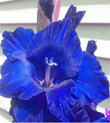 |
The
name Gladiola comes from the Latin Gladiolus (a
small sword) referring
to the shape of the leaves, so in the past
Gladioli (plural) were known
as Sword Lilies or Corn Lilies.
The plants have rounded to
flattened corms (bulbs) and narrow to broadly
sword-like leaves, produced
in fan-like tufts. Beautiful funnel-shaped
flowers grow on one side
of the spikes. Flowers open first from the
base of the spike with
the older flowers dying as new ones develop.
The Blue Sky Gladiola
(upper left) come in a very unusual color of pale
blue or lavender, fading
to white in the throat. The flowering
period period is July
through September, though blooms may appear sooner
in warmer climates.
Zone hardiness is important for the
Gladiola. The bulbs (corms) are
sensitive to freezing, and must be stored indoors
during winter in cold
climates. To keep your Gladiola plants safe,
refer to these hardiness
zone suggestions:
|
 |
Blue
Pansy
 |
Blue Pansies (or Pansy voilets) are a large group of hybrid plants cultivated as garden flowers. Pansies are derived from the Viola species, and have been hybridized with other Viola species, referred to as Viola wittrockiana or less commonly Viola tricolor hortensis (pictured left). The name Pansy also appears as a part of the common name for other Viola species that are wildflowers in Europe. Some unrelated species, such as the Pansy Monkeyflower (right), are very popular worldwide. Pansy are annuals, can grow up to 8 inches tall, and are hardy in all zones. Plants like regular watering, and do well in full sun to light shade, though full sun in zones 8-11 can kill plants after June. Plants and seeds widely avaiable online and at local nurseries and garden shops. | 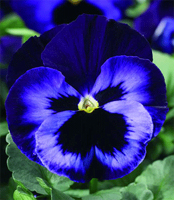 |
Blue
Cornflower
 |
The Blue Boy (left) and Blue Diadem (right) Cornflowers (Centaurea cyanus) are classic heirloom flowers with thistle-shaped, brilliant blue blossoms. Commonly known as Bachelor's Button, Cornflowers grow 2-3 feet tall on bushy plants up to 1 foot wide. Flowers can be up to 2.5 inches across. Blooming in both Spring and Summer, plants like full sun, and do best in zones 6-10. Available online from Renee's Garden and Backyard Gardener. |  |
Blue
Scabiosa
 |
 Pictured
on the left is the Butterfly Blue Scabiosa
(Scabiosa columbaria).
Scabiosa is also known as the "Pincushion
Flower." Another variety
is the Fama Blue (Scabiosa caucasica), picture on
the right, which dispays
the large fringed 3-inch flower with
pincushion-like centers that grow
on long wiry stems. Flowers bloom in the
Spring, continue all Summer
into Fall, and reach 18" to 24". Scabiosa
(scay-bee-oh-suh) make
an excellent cut flower, are winter hardy in zones
3-10, and are a good
choice for areas that don't receive a lot of water
or care. Available
from Spring Hill
Nurseries and Annie's
Annuals
and Perennials. Pictured
on the left is the Butterfly Blue Scabiosa
(Scabiosa columbaria).
Scabiosa is also known as the "Pincushion
Flower." Another variety
is the Fama Blue (Scabiosa caucasica), picture on
the right, which dispays
the large fringed 3-inch flower with
pincushion-like centers that grow
on long wiry stems. Flowers bloom in the
Spring, continue all Summer
into Fall, and reach 18" to 24". Scabiosa
(scay-bee-oh-suh) make
an excellent cut flower, are winter hardy in zones
3-10, and are a good
choice for areas that don't receive a lot of water
or care. Available
from Spring Hill
Nurseries and Annie's
Annuals
and Perennials. |
Blue
Daisy
 |
The Blue Daisy is really the Blue Marguerite (Felicia amelloides), a member of the Daisy family. A hardy annual, plants do best in full sun, zones 9-11, and grow up to 18 inches tall. Blooms late Summer through Fall. Available online from Dave's Garden. | 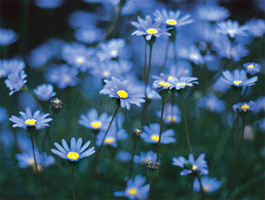 |
Blue
Chrysanthemum
 |
The Blue Knoll Chrysanthemum (Heteropappus meyendorfii) is a blue daisy-like flower with a yellow honey-combed center, complete cover mounding plant. This annual reaches up to 18 inches tall, and blooms from late Summer until Fall's first frost. Can be grown in all zones. Available online from Park Seed, Burpee and Dave's Garden. |  |
Blue
Hydrangea
  The
Blue Moon hydrangea (shown here) is a hybrid
(Hydrangea macrophylla), and
thrives in shaded areas, such as the north side of
a house, unlike other
Hydrangeas (Nikko Blue) which require full
sun. The shrubs grow into
large mounds of green leaves dotted with long
lasting 8 inch cobalt blue
flowers (called droopy pom-poms or
mopheads). This Hydrangea makes
a beautiful hedge, growing 3 to 6 feet tall and 4
feet wide. The
blue flower color depends on aluminum levels and
acid soil pH. Flowers
will be deep blue in acidic soil, lightening to a
very pretty light blue
to pink in alkaline conditions. The
Blue Moon hydrangea (shown here) is a hybrid
(Hydrangea macrophylla), and
thrives in shaded areas, such as the north side of
a house, unlike other
Hydrangeas (Nikko Blue) which require full
sun. The shrubs grow into
large mounds of green leaves dotted with long
lasting 8 inch cobalt blue
flowers (called droopy pom-poms or
mopheads). This Hydrangea makes
a beautiful hedge, growing 3 to 6 feet tall and 4
feet wide. The
blue flower color depends on aluminum levels and
acid soil pH. Flowers
will be deep blue in acidic soil, lightening to a
very pretty light blue
to pink in alkaline conditions.
If you have poor soil, add 3-4 tablespoons of aluminum sulfate to one gallon of water. Beginning in late Winter, drench the soil twice per month through late Summer. Acid soils usually contain plenty of aluminum. Hydrangeas prefer moist, fertile, well-drained soil. They are fully hardy in zones 7-11, but flower buds will be killed if temperatures drop to -10ºF (-23ºC). Hydrangeas shouldn't be pruned except to remove old flowers. The Blue Moon hybrid is available online from Michigan Bulb Company. |
Blue
Rhododendron
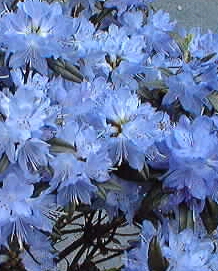 |
The Blue Baron, a Mezitt hybrid, is a hardy blue lepidote is from Weston Nursery, famous for hybridizing Rhododendrons. Grown best in zones 6-10, this shrub needs partial shade, since full sunlight tends to bleach the flowers and scorch the leaves. All rhododendrons need fertile acid soil with a pH of 5.0 to 6.0, well drained. The shrub blooms in Spring through early Summer, and grows 6 to 12 feet tall over a period of years. This stately blue hybrid is available at Weston Nursery, Hopkinton, MA: phone toll-free (800) 322-2002 or (508) 435-3414. Orders must be placed by January for Spring delivery. Also available from Blue Sky Nursery and Briggs Nursery. |  |
Blue Lisianthus
| Lisianthus is also known as the Texas Blue Bell and “the blue rose” (as pretty as a rose, a pure steel blue). These plants bear large, single or double flowers, and are slow to begin blooming. Grows best in loose, well drained rich soil, and full sun. Lisianthus germinate best at 70º to 75º Fahrenheit (21º to 24º Celcius), and are a wonderful plant for flower borders and patio containers. Seeds may be sown indoors at a 68º to 77º Fahrenheit (20º to 25º Celcius), 10 to 12 weeks before it's safe to plant them outdoors. These annuals grow to 2 feet tall. Grown in all zones, seeds are available online from Burpee. |  |
Blue
Rose
 |
 The
world's first true blue roses were unveiled
October 2008 at a Tokyo flower
show after 20 years of research and a $30 million
investment. The
blue flowers, which traditionally signify mystery
or attaining the impossible,
go on sale by early 2010, the company that
developed them said. The
blooms are genetically modified and implanted with
a gene that simulates
the synthesis of blue pigment pansies. The
world's first true blue roses were unveiled
October 2008 at a Tokyo flower
show after 20 years of research and a $30 million
investment. The
blue flowers, which traditionally signify mystery
or attaining the impossible,
go on sale by early 2010, the company that
developed them said. The
blooms are genetically modified and implanted with
a gene that simulates
the synthesis of blue pigment pansies.
Long thought impossible, the creation of blue roses was masterminded by the Melbourne, Australia, Florigene biotechnology subsidiary of Suntory Ltd., a Japanese brewing and distilling company. Past attempts by other organizations to create a blue rose were more accurately described as lilac in color. |
Blue
Lily
 |
Known as the Blue Lily of The Nile or African Lily (Agapanthus africanus blue), this flower is native to Southern Africa. It is grown for the dark, glossy, strap-shaped leaves, and deep blue flowers. The plant stems grow to 3 feet or taller, and make good background plants or edging along a fence. They can thrive on conditions of neglect and naturalize readily. They also make excellent tub and container specimens and can be used in cut flower arrangements. In cold winter areas they should be brought indoors for the winter. The blue flowers are rounded heads and trumpet-shaped, lasting from July to September. These beautiful African lilies provide valuable late summer blooms in a sunny, well-drained border. Grows as perennial in zones 7-9. Must be grown in pots and brought indoors in lower zones. Available from Mountain Meadow Seeds. |  |
Blue Thistle
 The
Blue Glow Globe Thistle (Echinops bannaticus and
Echinops ritro) is an
eye-catching addition to your flower beds.
Also called called Echinops
or Blue Globe, this dramatic-looking 3-4 foot
perennial has prickly, deeply
cut gray green foliage and many 2-inch intense
steel blue flowers in perfectly
round heads. They bloom through Summer and
Fall. The flowers
are terrific for fresh or dried arrangements, and
are hardy to zones 3-9.
Available online from Swallowtail
Garden Seeds and T's Flowers. The
Blue Glow Globe Thistle (Echinops bannaticus and
Echinops ritro) is an
eye-catching addition to your flower beds.
Also called called Echinops
or Blue Globe, this dramatic-looking 3-4 foot
perennial has prickly, deeply
cut gray green foliage and many 2-inch intense
steel blue flowers in perfectly
round heads. They bloom through Summer and
Fall. The flowers
are terrific for fresh or dried arrangements, and
are hardy to zones 3-9.
Available online from Swallowtail
Garden Seeds and T's Flowers. |
 |
Blue Sea Holly
 Blue Sea Holly
(Eryngium alpinum) displays gorgeous metallic blue
stems and flowers from late spring through early
fall. The variety "Saphire Blue" (pictured
right) offers the largest flowers, starting out
green then darkening to an intense blue that
almost looks spray-painted. The sunnier the
location, the bluer the plants become. They
look like thistles with a star-like collar at the
base of each bloom. The Sapphire Blue
cultivar is a sterile hybrid, and thus is not
invasive like the wild form in the
Northwest. The flowers dry out in autumn
with considerable ornamental appeal for
long-lasting dried flower arrangements. Growing up
to three feet tall, they do best in zones
5-9.
Available online from Swallowtail
Garden Seeds and T's Flowers. Blue Sea Holly
(Eryngium alpinum) displays gorgeous metallic blue
stems and flowers from late spring through early
fall. The variety "Saphire Blue" (pictured
right) offers the largest flowers, starting out
green then darkening to an intense blue that
almost looks spray-painted. The sunnier the
location, the bluer the plants become. They
look like thistles with a star-like collar at the
base of each bloom. The Sapphire Blue
cultivar is a sterile hybrid, and thus is not
invasive like the wild form in the
Northwest. The flowers dry out in autumn
with considerable ornamental appeal for
long-lasting dried flower arrangements. Growing up
to three feet tall, they do best in zones
5-9.
Available online from Swallowtail
Garden Seeds and T's Flowers. |
 |
There are
other
blue flowers not shown here, such as Aster, Crocus,
Hibiscus, Morning Glory,
Phlox and Scilla. If you know of a blue flower that
should be added
here, please include the flower name, where available, and
any details to the email
link below.
Some popular flowers not yet available in true blue are
Amaryllis, Begonia,
Carnation, Daffodil, Dahlia, Foxglove, Holyhock, Peony and
Zinnia.
|
|
||
|
|
|
|
|
|
|
|
|
|
|
|
|
|
|
|
|
|
|
|
|
|
|
|
|
|
|
|
|
|
|
|
|
|
|
|
|
|
|
|
|
|
|
|
 |
||
Your questions, comments, and suggestions are welcome. Thank you for visiting!
